
My roommate and I recently had a housewarming party; we had a whole spit roasted lamb as part of the menu. Needless to say, there was quite alot of lamb left. I decided to make migas the following morning for breakfast. When they were done my roommate looked at them qizzically; I said "Oh, those are migas with lamb", and he responded"Hm, they don't look like migas", I said "Well, they're Spanish migas"; my roommate looked, well, doubtful.
Here in the U. S., and in Texas particularly, we think of migas as a dish of torn or chopped corn tortillas fried crisp and mixed with scrambled eggs, as well as, other ingredients depending on the traditions of the region where they are made. Iam sure that Mexican and Tex-Mex migas get that moniker because they use a chopped or shredded starch product, namely, corn tortillas.
In Spain and Portugal migas are always prepared from "crumbs", you see, that is what the Spanish word migas means.These crumbs are usually bread crumbs, but sometimes they are made from toasted semolina wheat flour. Migas are usually sauteed in olive oil and garlic, other ingredients such as meats, sausages,or vegetables are added depending on the part of Ibereia in which the cook lives. The result is a dish of crisp/tender seasoned cumbs flavoredby all the ingredients cooked along with them. They are eaten at all times of the day, and evening; there are even festivals for migas, the most famous taking place in Andalusia at the time of the pig slaughter.
When one sees a pot of Iberian migas it is not hard to see the similarity between them and couccous; in fact, the migas made from semolina flour are so similar one might think they were fried couscous. The prvailing thought is that during the Reconquista, when Muslims were forced to convert to Christianity, many of the Islamic foodways were modified to reflect the Christian dietary values; and overtime the culinary system of Islam was superceded by the traditions of Christian cooks, so, certain techniques fell out of favor.
Thus, breadcrumbs began to replace couscous as a bed for sauces or as a cereal preparation, and ingredients like serano ham, morcilla sausage, and chorizo began to be added for flavorings, in order to legitimize the dishes, so, suspicion of the secret practice of Islam would not fall upon the cook or her family.
Today I would like to share with you a couple of recipes for migas and couscous and as you read them, and especially when you prepare them, take note of the similarities and the differences, and remember like migas and couscous, The Children of Abraham all have different techniques and recipes for living for, praying to, and thinking about God; but we are all a product of the causation of the same God, thus we are all brothers, sisters, and cousins in the eyes of God.
Migas
 |
| Migas |
- 1 loaf of stale (one-day-old) bread, with a lot of substance.
- 100 grams of fatty bacon
- 100 grams of chorizo or ham
- 2 dry red peppers
- Paprika
- 2 cloves of garlic
- olive oil
- salt
- 2 eggs
PREPARATION:
- Cut the bread into tiny pieces and dampen in a little water, salt and paprika. Cover the breadcrumbs with a cloth and leave to stand for 12 hours.
- Fry the crushed garlic and sliced peppers in 4 tablespoonfuls of oil and then drain.
- Fry the diced bacon in the same oil. Then lightly fry the chorizo or ham, and drain off the fat.
- Leave 1 tablespoonful of oil in the pan and fry the bread for about 2 minutes.
- Add the bacon and chorizo and fry lightly until the bread is golden, stirring constantly.
- Garnish with the fried garlic and peppers and serve.
- Eat together with fried eggs. reprinted from tour Spain.com.
- Migas de Hrina
This is the traditional Andalusian method that our friend and neighbour Isabel uses to cook migas.
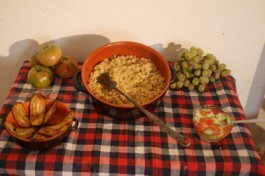 Ingredients
- 4 cups of water
- 6 cups of flour
- 1 cup of Olive oil
- Salt to taste
In a large saucepan heat the water and salt until it begins to boil. Add the flour and stir until it becomes dough-like. Heat the olive oil and add it to the dough mix while stirring. Continue to stir until until the oil is absorbed and the dough breaks up and becomes golden and crispy. reprinted from All Box Info.
Couscous with Seven Vegetables
Ingredients for 6-8 servings
- 1.5 kg (3 lb.) fairly fatty mutton (shoulder or saddle)
- or Veal (neck, breast, shoulder or shank)
- 1 cabbage (about 800 g / 1 3/4 lb.)
- A piece of stale bread
- 1 tbsp. lemon juice
- 4 cloves
- 1 kg (2 1/4 lb.) onions
- 250 g (9 oz.) chickpeas, soaked overnight
- 150 g (5 oz.) butter
- A pinch of Saffron
- 1 tsp. pepper
- 6 liters (24 cups) water
- 1 kg (2 1/4 lb.) Semolina
- 250 g (9 oz.) peeled seeded tomatoes
- 250 g (9 oz.) small peeled turnips
- 500 g (18 oz.) carrots, peeled and cut into long sticks
- 3 sprigs of cilantro
- 2 hot peppers
- 500 g (18 oz.) pumpkin
- 250 g (9 oz.) sweet potatoes
- 100 g (3 1/2 oz.) olives
Method
 |
| Couscous with vegetables |
- Cut the meat into 10 equal pieces; wash and drain carefully.
- Remove the stem and core from the cabbage by making a deep incision with a sharp knife. Blanch for 5 minutes in boiling water with the lemon juice and stale bread.
- Place the meat into the bottom part of a couscous maker with the blanched cabbage, two onions each stuck with 2 cloves, the chick peas, saffron, pepper, salt and water, and place over high heat.
- Pour the couscous into the upper part of the couscous maker and place over the simmering pot. The steam should escape only from the top: if this is not the case, seal the two parts together with a strip of cloth coated with a light paste of flour and water. Once the steam begins to come out, allow 30 minutes of cooking time.
- Remove the couscous, place in a large deep dish and separate the grains by rubbing them between your palms or crushing them with a ladle. Moisten with 2-3 ladlefuls of cold lightly salted water, separate the grains and let rest 15 minutes.
- Add the remaining sliced onions, tomatoes, turnips, carrots, cilantro and chilies to the broth.
- Remove a little broth and cook the squash and sweet potatoes separately.
- Once the broth returns to a boil, repeat the previous procedure with the couscous, but this time replace the water with olive oil.
- Return the couscous to the top of the couscous maker and 5 minutes after the steam begins to escape, once again separate the couscous grains with butter.
- Check the doneness of the meat and vegetables and correct the seasoning.
Couscous de Ceramonie
4 cups semolina couscous
1 cup raisins plumped in hot water
1 cup cooked chick peas
boiling water to cover pasta
1 T. butter or1/2 T. sunflower oil
1cup toasted slivered almonds
 |
| Couscous de ceremonie |
cinnamon and powdered sugar to taste
1 ts. salt
Mix together the salt and couscous, stir in the raisins and the chick peas. Pour over the boiling water and allow to sit tightly covered with plastic or a lid for 15-20 minutes or till all the liquid has been absorbed by the couscous. Mix in the butter or oil, and then mound pyramid-ally on to a warm platter . Using your thumb and forefinger drizzle stripes of cinnamon and sugar, alternating as you go, down the sides of the pyramid. Lay stripes of almond between the lines of sugar and cinnamon. Bring to table and serve. Excellent warm or at room temperature.
I hope you take the time to try these dishes, and keep in mind that one is a reflection of the other, just as we , the Children of Abraham are reflections of one another.


